
On Writing the Hard Thing: A Killing of Oneself. A Tendency.
An Excerpt from Grant Faulkner's memoir Heart Failure: A Maniac’s Story, followed by a conversation on process



This month’s On Writing the Hard Thing with Grant Faulkner explores the thoughts we have that frighten other people. The thoughts we have, but often hide because once spoken, they might change the way someone sees us. They might change everything.
I first connected with Grant here on Substack, after he stumbled across an old pandemic project of mine called Words After Dark, where, to keep myself sane, I made these little cinematic videos of myself reading passages from a self-published book I’d written called From the Dust, along with excerpts from some of my favorite books. It was a relic from another version of my creative life, another version of myself—pre-motherhood, pre- the bone-deep exhaustion I almost almost feel now (how did I ever have the time to do something so spacious?)—and I’d almost forgotten it existed.
Since then, every so often, I’ll receive a message from him while he’s driving through the Mojave Desert, where I grew up and have since escaped. I like these messages. I like hearing from him inside that sun-scorched landscape. He feels a little like a messenger from a past life, writing to say, Hey, it’s all still here. The heat and the white light and the endless stretch of sky. The place I built my whole self around leaving.
A reminder that I did.
Maybe that’s part of what makes Grant so magnetic to me as a writer, as a human. He understands that the places we leave don’t stop existing just because we’ve escaped them. And neither do the lives we’ve lived there or the versions of ourselves we had to become in order to survive.
Grant is a truth-teller, but more than that, he is interested in the nature of truth itself. He writes toward it, circles it, turns it over, expands it, and through his work, he helps other writers find a way into the hard truths of their own lives. This is something we all need. The hardest truths are rarely hard only because they hurt. They’re hard because we don’t have language for them, because the memory that holds them is often fragmented, because they can hold two seemingly opposing things at once: I wanted to die, and I wanted to live.
The excerpt Grant shares here comes from Heart Failure: A Maniac’s Story, a memoir about a terminal diagnosis of heart disease that opened up his life to him—from the ulcers he experienced in his teens to the life-long insomnia that started in his twenties to the severe carpal tunnel that waylaid him in his thirties to the chronic fatigue syndrome he suffered in his forties. Each of these ailments seemed isolated, unto itself, but Grant realized they all came from the same source in the end: he’d lived a maniac’s life.
In this piece, Grant writes about his experience of suicidal ideation beginning in childhood— something he had largely kept a secret for his entire life. He doesn’t force it into a simple story about wanting to die and he doesn’t break it down into something easier for a reader to swallow. Instead, he stays inside the contradiction and it’s so damn powerful from the very first line to the last that it left me breathless.
Then, in the conversation following the excerpt, he takes us further into what it means to write about a truth the world has made almost no room for. Into what actually changed when he finally gave that truth a voice, out loud, to the people closest to him. And why he believes our stories can quite literally save us.
Something I too believe deeply. Something I know firsthand.
This is the first time Grant has truly gone public with this and I want to thank him for trusting this series with his truth, for trusting me. If you or someone you love recognizes any part of yourself in this piece, you’re not as alone in it as the culture wants you to believe.
Take a breath before this one. Then read.

A killing of oneself. A tendency.
1
I can’t remember a time in my life when I didn’t think of committing suicide.
2
One night, when I was eight years old, I dressed in my snow boots and my winter jacket, and I walked out into the back yard and lay down in the snow and made a snow angel. Except I wasn’t there to make a snow angel. I wanted to freeze to death. I lay in the snow, the darkness enveloping me, and I decided I would lie there until I died.
I don’t think there was any particular catalyst for this. I don’t remember being wronged or unjustly punished. I just remember the pull of death. It’s a pull that has always seemed hard wired into me because I’ve never not felt it. I didn’t know it was odd for an eight-year-old to think about suicide.
I lay in the darkness, the cold snow snuggling into my back, and I stared at the warm orbs of light in my house as the chill needled my cheeks. I was separate from it all, drifting in my own orbit. I lay outside for an hour or so, waiting to die, but then I got bored and hungry and went back inside. Still, I remember finding a strange peace in that hour. A solace I didn’t know how to describe.
It’s funny because if you met me, you wouldn’t think of me as having any of the warning signs of suicide. I’m jolly, gregarious, adventurous, loving, giving. I like to crack jokes. I like to stir things up. I like to tease and banter. I like to bring people together. I enjoy my life. I’ve never thought of myself as having more than the usual angst of a writer. To be a thinker is to be anguished in some way, by definition, but I never thought my anguish led me to a too-dark place. I love reading the existentialist philosophers, but I wasn’t a Kafka or a Nietzche by disposition. I drank a lot, of everything, but I thought of my drinking as hearty drinking, living with gusto, and I exercised in similar ways, with an intensity that spoke of liveliness to me. I was a long-distance runner. I was a person who endured.
And yet I’ve imagined dying by my own hand for a lifetime. My life has been a type of suicide watch. I’ve thought about it every day, and in all sorts of scenarios—by gun, by pills, by slicing veins, by needle, by jumping. What most people can’t fathom is that my thoughts of dying, as horrific as they might seem, have also been comforting.
Release. Relief. The need to disappear. To be elsewhere. The need for quiet. To be at peace.
The idea of suicide has actually been a kind of lifetime companion, an unacknowledged friend. When I’ve thought of suicide, it’s as if I’m turning a valve, calibrating whatever hurt and sequestered rage or shame is within me, and turning it to let the pressure out. “The thought of suicide is a great consolation: by means of it one gets through many a dark night,” said Friedrich Nietzsche.
I have often gone to sleep imagining my death. In the beginning of the night. In the middle of the night. At the end of the night.
Here’s my existential paradox: I will want to die until the moment before I die.
3
In high school, I began cutting myself. In moments of anguish, in moments of drunkenness and rage, in moments of shame, I’d hold a pair of scissors to my forearm, press the blade into my flesh, and then … the rush of the slice through the skin—relief, like a breath, as I watched the blood rise and fill my wound.
One pain takes over another pain.
The difference between cutting and suicide is about intent. To cut is not to intend to die, but to seek relief.
But suicide is also a search for relief.
I hid the slice marks on my forearm by wearing long sleeved shirts, yet I wanted the world to see them.
One definition of being a human being: wanting others to see your pain.
Another definition of being human: not wanting anyone to see your pain.
Both definitions were true for me at the same time.
4
One pain takes over another pain.
I ran cross-country in high school for the pain. I chanted, “Kill the hill,” as I pushed my body up each hill. I loved to pass the runner ahead of me midway up a hill. I loved running hard and long because I loved that I could ride the pain, thrive on the pain, endure more pain than others. I flogged myself with each stride. And after a while, I started to float, even as I heaved for each breath, creating a new pain, a new solace, with each desperate lunge of my step. I ran to die.
5
Suicide. Originating from the Latin sui “of oneself” and -cidium “a killing,” suicide means the deliberate act of killing oneself.
A killing of oneself.
Except it’s also an expression of oneself.
A feeling beyond words.
It’s an escape of oneself.
Or an escape from life.
It’s a quest.
It’s a blanket.
It’s a destination.
It’s a surrender.
It’s a salvation.
6
“I have always believed that, between living and dying, from being to being no longer, there are secrets understood by those nearer death,” said Yiyun Li.
7
Science: When a person cuts compulsively, the brain begins to associate the experience with relief. As tension builds, the body begins to crave the feeling it experiences during cutting.
Religion: Many people have flogged themselves as a means of penance for their sins. Self-flagellation—a means to reach the sacred, a means to find peace.
We search in death for the things we cannot find in life.
Perhaps I cut myself because I was paying for my sins. The sin of being me.
Perhaps death, especially killing oneself, is the ultimate surrender. That’s what I’ve been looking for my entire life: surrender. Surrender of self. Surrender of ego. Surrender as a way to reach something higher.
8
How do you tell anyone that you have suicidal tendencies?
“Good morning. How are you?”
“I’m good. I’ve been imagining sticking a gun in my mouth and pulling the trigger for the better part of this morning.”
I have never wanted to talk to anyone on a suicide hotline about this. I have never wanted to be rushed to the emergency room.
It’s too much a part of me. And I’ve always been fine with that part of me. Because I know I will never commit suicide. Even when I don’t know if I will commit suicide, I know I won’t commit suicide. Because I’ve thought about it so much. I’ve thought about suicide too much to do it.
9
“The worst part of having a mental illness is people expect you to behave as if you don’t.”
— The Joker
10
Quiet. I just want quiet.
My hurt head. My bad head. There’s a drill in it. A drill on the loose. The only thing that quiets it is booze. I’m sorry, but I need the quiet. And the place to find it is in the booze. And whatever else is at hand. Whatever will soften. Whatever will soothe these jagged thoughts that rip through my mind, cutting up everything in their path. How to describe it? A traffic jam in my head. A racetrack. A war of knots and pricks, pinches and prods. A cauldron of mixed metaphors.
I take an edible. I take a drink. I take another drink. I take another drink.
11
The movie Ordinary People came out when I was 16. I’d never felt myself so intensely in a story than as Timothy Hutton’s Conrad. The film is about a wealthy suburban family unraveling in the wake of a boating accident that killed their older son. Hutton plays Conrad, the surviving younger brother. He looks so jittery and pale and sleep-deprived that he appears as if he has forgotten how to inhabit his own body. He’s hunched, watchful, as though he’s taking up too much space. I felt myself in the way his eyes tracked a room before he entered it, the way he flinched before he answered a question.
My friend Sid (not his real name) and I went to see the film over and over again. Sid was the only person I’d told about my suicidal thoughts. He’d had the same thoughts. We recognized each other as fellow suicidal travelers. The brotherhood of suicidals. I can always spot them. It’s my “suicidar.” We started dressing like Timothy Hutton did in the movie. We wanted to see a therapist like he did. Of course there were no therapists in Oskaloosa, Iowa. There wasn’t even a suicide hotline back then, in the early 80s.
Our favorite band was Joy Division, and Ian Curtis, their singer, was all the more legendary to us because he had committed suicide. He hung himself in the kitchen of his home in Macclesfield, England. He was 23 years old. Joy Division was scheduled to leave for their first American tour the next day.
The night before his suicide, he’d spent the evening alone. His wife had taken their young daughter to her parents’ house after another difficult period in their marriage. He watched Werner Herzog’s Stroszek, a bleak film that ends with a suicide, and listened to Iggy Pop’s The Idiot repeatedly. He left the record player on.
He performed his suicide through his music:
“I’ve been waiting for a guide to come and take me by the hand” (“Disorder”).
“Where has all the passion gone? / Or is it still newly wed?” (“Love Will Tear Us Apart”).
“This is the crisis I knew had to come / Destroying the balance I’d kept” (“Twenty Four Hours”).
Sid and I drove for hours listening to Joy Division, drinking quarts of beer, smoking pot. Friends described Curtis as someone who refused help, who seemed determined to experience everything at maximum intensity. He wouldn’t moderate drinking despite how it triggered his epileptic seizures. Bernard Sumner, a guitarist with Joy Division, later said Curtis seemed to be “living on the edge” deliberately.
12
My question: where would anyone want to live other than the edge?
13
“The frequent attempt to conceal mental pain increases the burden: it is easier to say ‘My tooth is aching’ than to say ‘My heart is broken.’”
— C.S. Lewis
14
We don’t have a good vocabulary for suicide. The language we do have is either clinical and sanitizing, religious and condemning, or euphemistic—“took his own life,” “lost her battle.” For centuries in Western culture, suicide was classified as a mortal sin—the gravest possible offense against God. God gave us life, after all. And a suicide has the audacity to say, “Fuck you, God, I don’t want the life you gave me.”
Bodies of people who died by suicide were denied burial in consecrated ground. This theological condemnation created a cultural sentiment that persists today, even in secular contexts. There’s a sense that there’s something wrong or shameful about the subject of suicide itself.
15
My bruised brain. I live with an ache. A sad ache. A yearning ache. A melancholic ache. But now I also live with loads of anxiety. Anxiety that has been accumulating for years. Anxiety that batters and pokes and yells. Anxiety that bangs all around looking for something but can’t find it. Anxiety that holds an ice pick.
16
Most suicide attempts are impulsive. Studies of Golden Gate Bridge survivors show that 90% didn’t go on to die by suicide.
“I instantly realized that everything in my life that I’d thought was unfixable was totally fixable—except for having just jumped,” said Ken Baldwin, a Golden Gate Bridge jump survivor.
17
I have wondered, is being a writer an act of suicide, even as it is an attempt to live forever?
That’s what so many suicides seek, right? To live forever in others’ thoughts. To leave life with an eternal question: Why?
A suicide’s muted cry: you did not care for me enough.
Except it’s a loud cry, loud not in sound, but in intensity, an echo that never quits crying.
Suicide is a ripping off of a mask. Just as writing a memoir is the ripping off of a mask. And putting on a different mask, perhaps.
18
Suicide’s Note
By Langston Hughes
The calm,
Cool face of the river
Asked me for a kiss.
Coda: Nearly two years ago, Grant asked his doctor for anti-anxiety medicine. Upon further examination, his doctor theorized he’d suffered from chronic depression his entire life. She diagnosed Lexapro, an anti-depressant, and as he says, “It was like turning on a light.” Not only did the weight of his depression lift, but the suicidal ideation lessened to a degree he’d never experienced. Now he rarely thinks of suicide at all.
What is the “hard thing” at the center of this piece—for you, personally, not just on the page?
Suicide is a very taboo subject in our culture. People avoid talking about it, and the taboo strangely seems to be firmly rooted in what it means to be human. I’ve noticed that when a parent loses a child to suicide, people start avoiding them, and sometimes the parents avoid other people themselves, because there is a shame or stigma they carry. This applies to me as well. I had a friend whose child committed suicide, and as much as I wanted to talk with him about it, I didn’t know how to do so. I avoided the subject, even though his daughter’s death filled the room, filled my thoughts.
Recently I’ve begun to tell people about my own history with suicidal ideation, since this is a part of my memoir. I’ve had people be aghast, as if something is wrong with me. Which is one reason I don’t talk about it—I don’t want people giving me 800 numbers or wanting to rush me to the hospital. I’ve lived with this my whole life, and it’s become a strange friend. But it’s always hard to talk about something when there is no place for that something in our world—when your feeling doesn’t belong, can’t find proper words.
What helped you regulate, or at least be present, while writing this piece?
I always say writing is my form of prayer. It’s really my only true time of peace, even when sitting in the discomfort of a creative impasse. My primary duty as a writer is to be vulnerable and open, to break through taboos, to tell the stories others might be afraid to voice, to open up a bond of connection. So I was present with this piece because its subject is so deeply a part of my soul, my existence, and I wanted to give it a voice.
What changed for you after writing it, if anything (internally or externally)?
I’m more comfortable talking about all of this in public, like I’m doing now. No one has ever known this about me. It’s been especially good to tell my wife and kids about it because it opened a door for us all to talk about the sometimes strange and troubling workings of our minds. After writing this, I’ve also been able to talk casually about it, without any drama, as if I have nothing more than a cold.
For someone standing at the edge of their own hard story, what would you want them to know?
There’s the old Alcoholics Anonymous line, “We are only as sick as our secrets.” I believe that our stories literally save us—as individuals and as a society. We are creatures who seek love and belonging above all else, and it’s such a fantastic, miraculous, magical thing to find love and belonging in another’s words. None of us want to be alone. If you’re standing on the edge of your own hard story, please know that someone wants to hear it, even if you might be that someone.
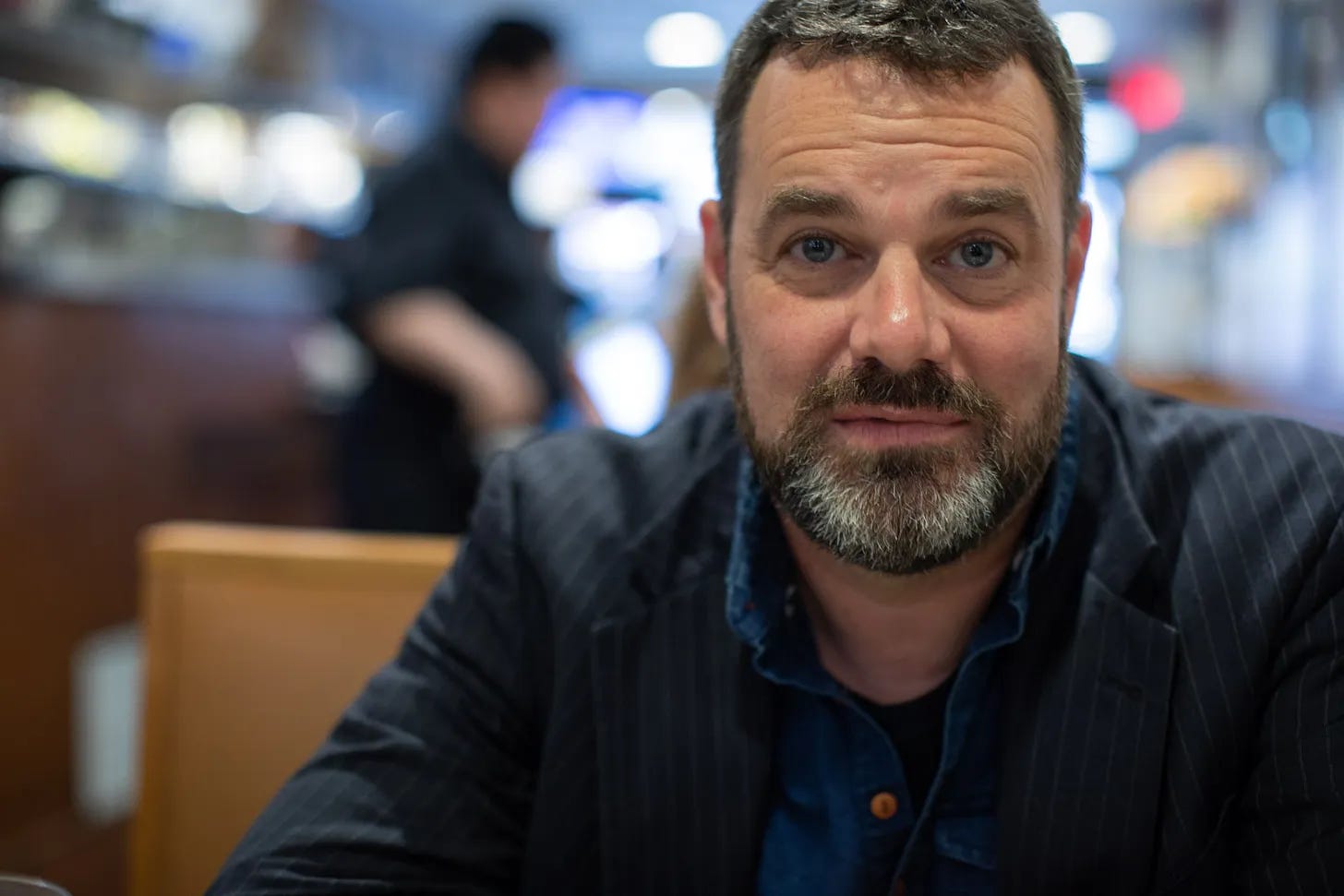
Grant Faulkner is the co-founder of 100 Word Story, the co-host of the Write-minded podcast, co-founder of Memoir Nation, and an executive producer on America’s Next Great Author.
He has published three books on writing: The Art of Brevity: Crafting the Very Short Story; Pep Talks for Writers: 52 Insights and Actions to Boost Your Creative Mojo; and Brave the Page, a teen writing guide.
He’s also published All the Comfort Sin Can Provide, a collection of short stories, Fissures, a collection of 100-word stories, and Nothing Short of 100: Selected Tales from 100 Word Story.
His “flash novel,” Something out there in the distance, a collaboration with the photographer Gail Butensky, was published this year.
His stories have appeared in dozens of literary magazines, including Tin House, The Southwest Review, and The Gettysburg Review, and he has been anthologized in collections such as Norton’s Flash Fiction America; New Micro: Exceptionally Short Fiction; and in several editions of the annual Best Small Fictions and Best Microfiction anthologies.
His essays on creativity have been published in The New York Times, Poets & Writers, Lit Hub, Writer’s Digest, and The Writer. He serves on the National Writing Project Writers Council, the LitNet Steering Committee, Litquake’s board of directors, and the Aspen Institute’s Aspen Words’ Creative Council. He also publishes the weekly Substack, Intimations: A Writer’s Discourse.
Where to find Grant:
Website | Substack | Podcast | Buy His Books
 | A guest post by
|
Thank you, Grant. As someone who felt similar as a child and became a "cutter" in my teens - your words felt like a calm, steady hand on my shoulder. My experience involved even more trauma and drama when I was "found out". The school district, CPS, psychiatrists and court-ordered everything added pressure to a valve that was already impossible to contain. There was nowhere to get relief. I left home as soon as I could and found any and everything to "numb" out. I quit drinking almost 6 years ago (best.decision.ever) and as some know - everything changes. Relationships. Priorities. Coping tools. Anticipatory anxiety got the best of me earlier this year while dealing with loss/grief. My self-soothing became self-harm and I have developed trichotillomania. Something I had never heard of. It's been rough. BUT "we are only as sick as our stories" - I have begun talking about this experience very recently and it feels like a weight has been lifted.
My new outlook is: "share it, don't shame it."🩷
Thank you for sharing. Truly.
A powerful piece of writing, Grant. What I love about this is all the perspectives I hadn't considered. Suicidal ideation is as layered and nuanced as a the person who's having them. The gift of these personal pieces is that they open a portal to the person writing, but also to all the people we know (perhaps ourselves included) who have similar dispositions or thoughts or experiences. We always talk about how it promotes or breeds empathy, and I took away a much-needed gem in here about someone I love. So you helped me understand something better. Thank you for this writing, and for sharing. And for modeling! And thanks, Jessy. Can't wait to have you on Memoir Nation.