
A Somatic Writing Practice for Hard Memories
Somatic Craft Letter—Using Breath and the Alphabet Form to Hold Memory

A short note before we begin (and an event invitation)… For the past year, this space has been devoted to the serialization of my memoir, The One Who Leaves. Now that the book has come to its close, I’ll be sharing more of the practices that live underneath my writing—the ways I approach difficult memory, the structures that help the nervous system hold a story long enough for it to arrive on the page.
These Somatic Craft Letters will live on the paid side of the newsletter moving forward, but today I wanted to share one with everyone to give you a small glimpse into the kind of work we’ll be doing here. If you’ve ever sat in front of the page with a story you don’t know how to approach, this practice is for you.
And if you’d like to experience this kind of writing in a live guided space, I’ll also be hosting a free, hour-long somatic writing session on March 21 at noon ET. It will be a small preview of what we do inside my community, The Inner Room. You can save a spot here.
This morning, the house was still blue and quiet when I opened my notebook to write. My son had already been awake long enough to leave a collection of gifts on my desk—three smooth stones, a curled brown leaf, and a dandelion bloom. He likes to leave me little offerings from the natural world, as if the earth itself is reminding me us to look more closely (because of course it is).
I sat there for a while before writing anything, staring out at the black walnut tree, reminding myself to breathe. I had the doc open, the cursor blinking, waiting. And I was waiting, too, for the memory to arrive, the feeling, something.
Sometimes a memory arrives and I can follow it the way you might follow a path through the woods, trusting that if you keep walking long enough, it will lead you somewhere. But today, the path felt unclear, distant, even guarded. I used to think these moments meant I wasn’t ready. That maybe the memory was too big or too painful or simply beyond my ability to shape. That maybe I just wasn’t a good enough writer after all. (Hello, inner critic.) But over the years, slowly, through countless false starts and abandoned pages, stories, almost entire books, I’ve learned that often it’s not the story that’s the problem (or our writing abilities). It’s the space we’re asking it to enter, how we’re expecting it to arrive.
When the nervous system doesn’t feel safe, the mind will circle the story forever. Some memories are simply too wide, too heavy to hold all at once, so they move through us in fragments—an image, a smell, a single sentence someone once said, the sound of someone’s laughter. The sound of my father’s big laugh in my head can drop me instantly into a memory. I swear it’s like a car backfire—sudden and explosive, rising up from somewhere deep inside, as if it surprised even him. But when we try to force these fragments into a smooth narrative too quickly, the nervous system presses the brakes and the writing stalls. There’s too much pressure. Too much heat.
This is where form can become an unexpected ally. A structure, especially a small one, can give the mind something to hold while the deeper material begins to rise to the surface. One powerful example comes from Natalie Diaz in her poem Abecedarian Requiring Further Examination of Anglikan Seraphym Subjugation of a Wild Indian Rezervation. As you may have guessed from the title, the poem is written as an abecedarian, which is a form structured by the alphabet. Each line or section begins with the next letter—A, then B, then C, and so on.
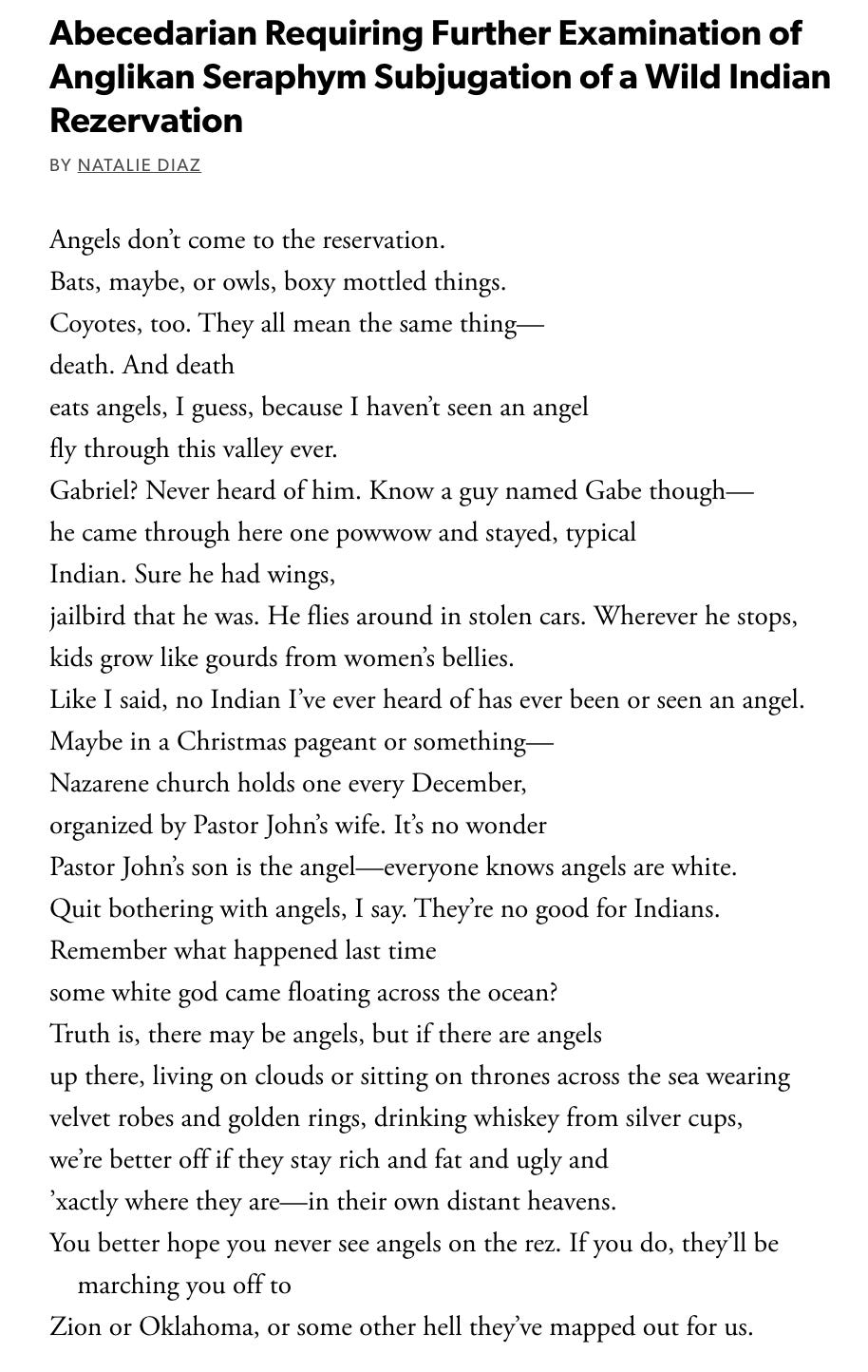
The alphabet feels almost childlike, something we learned before we even understood language, but Diaz uses that familiar structure to carry something much heavier… history, violence, memory, colonization. The alphabet becomes a kind of scaffolding where each letter is a step forward and each step is small enough that the writer (and the reader) can keep moving.
What intrigues me most about this form is the way it allows the poem to move through painful material without demanding immediate coherence. The structure holds the weight so the writer doesn’t have to. I mean, what a gift. The writer doesn’t have to explain everything all at once. Instead of asking the story or memory to arrive fully formed, the alphabet simply asks the writer to continue. A stepping stone through the forest of our past. A, then B, then C. One small step after another.
This is something poets have long understood, and part of why I’m so drawn to poetry in the first place—sometimes limitation opens a door that freedom cannot. Constraint can create a kind of safety on the page, a structure strong enough to hold what wants to unfold. And this is exactly what the body often needs when we’re writing memory, when we’re approaching the stories that live close to the bone, the ones that carry a quickening pulse. The stories the body has been holding for years, sometimes decades, waiting for a moment when it might finally feel safe enough to open.
Opening Grounding
Before we move into the writing invitation, I’d love to invite you to take a moment to settle into your body and your breath. Writing difficult memory asks a lot of the nervous system and so it helps when we give the body a few moments to arrive first. You can move through the grounding below at your own pace, or if you prefer, you can listen to the audio version.
Let’s begin by taking a deep breath in through your nose… and release, exhaling through your mouth.
Now, lift your eyes from the page and let them move around the room you’re in. Notice where you are. Notice the shapes, the light, the colors. Let your body register something steady—a wall, a tree outside your window, your desk. Something that tells your nervous system, I’m here.
Notice the ground beneath you. The chair holding your body. The feeling of your feet touching the floor.
Take another slow breath in through your nose. And a longer breath out through your mouth.
Again—inhale, filling your belly. And release.
Now, take a moment to check in with yourself.
What sensations are present in your body right now?
What feelings are here?
What thoughts or worries might be moving through you as you arrive at the page?
There’s nothing you need to fix or change. Just notice what’s here.
And if it feels supportive, place a hand somewhere on your body—your chest, your belly, your arm—just a small reminder that you’re here with yourself.
Writing about memory can pull us far away from the present moment, so if you’re someone who tends to disappear into the past when you write, you might gently remind yourself… I can enter the story, and I can leave it.
You’re here. In this room. In this moment.
Take a final deep breath in… and exhale.
Writing Invitation: Write an Abecedarian Memory
For this exercise, you’ll write an abecedarian memory.
Start with the letter A. Write one sentence or fragment that begins with A. It doesn’t need to be perfect or even complete. Let it be sensory, concrete, specific. Then move to B. Continue moving through the alphabet, one letter at a time. You might write a full sentence or just a fragment. You might discover the lines connect to one another, forming a loose narrative or they may remain scattered and somewhat separate. All are welcome. You don’t need to explain what the memory means. Let the details carry the feeling.
Here’s a simple example of how this might look:
A — Abandon always looks the same in the parched heat of the desert.
B — But she said she was coming back (why didn’t she come back?).
C — Cigarette smoke drifts through the screen door and
D — damn, I swear I can see the shape of her on this wildfire night
And so on.
You don’t have to reach Z. The alphabet is simply a path that keeps the writing moving forward.
If it helps to set a timer so you know when you’ll step back out of the memory, you might do that now. Ten minutes can be enough. Or you can simply write until the piece feels complete for today, until your body gives you the signal that that’s enough. Remember, we’re not trying to push through here. We’re building trust and safety and capacity, and letting the constraint of the form help hold the memory while it unspools. This practice is not about how much you write, but rather how you stay with your body while you do.
Closing Grounding
Before you move back into your day, take a moment to come back to your breath. You can close your eyes here if that feels good.
Inhale slowly through your nose, letting the breath fill your chest and belly. Then exhale through your mouth.
Again. Slow breath in. And a longer breath out.
Let your shoulders drop. Release your jaw. Soften your belly.
Notice what your body feels like now compared to when you began.
Take one more steady breath in through the nose. And release.
If the memory still feels close, imagine the breath creating a little space around it. The story can stay on the page for now. You don’t have to carry it with you.
Let your breath return to its natural rhythm.
And when you’re ready, gently open your eyes.
Sharing Invitation
If you feel comfortable, you’re welcome to share a few lines from your abecedarian in the comments. Witnessing each other’s fragments is part of how we learn that these stories, no matter how difficult or scattered, were never meant to be carried alone. One true line is often more than enough, but I’m here for all of it.
Join me for a free somatic writing session…
If you enjoyed this practice and want to experience what it’s like to write this way in a live guided space, I’m hosting a free one-hour somatic writing session this Saturday, March 21 at noon EST. We’ll settle the nervous system, move into a writing invitation, and spend time writing together in quiet. There will be optional sharing and space for connection. It’s a small sneak peek into the Inner Room. You can join us here.
PS:
If this way of writing speaks to you, it’s the kind of practice we return to again and again inside The Inner Room, a somatic writing community for women who want steady ritual, nervous-system support, and real connection they can build a sustainable rhythm around.
We begin each weekly writing session by settling into the body and the breath before we ask memory to open on the page. From there, we write together in quiet, following invitations that help us approach the story without forcing it. What makes the work powerful, though, is the collective container. When people write alongside one another, each tending their own story, but doing so in the presence of others, I can tell you that something begins to shift. The body starts to understand it isn’t alone with what it carries. And the stories that once felt impossible begin to trust the space you’ve made for them.
Inside the community, we also gather for deeper monthly craft workshops, open mic readings, and a private space where women can share their work and be witnessed by others who are doing this work. This isn’t just a writing group. It’s a place where the rhythm of returning week after week allows the work to deepen. Where breath, body awareness, and relational support make it possible to approach the hard stories that once felt too heavy to carry alone.
The spring season begins April 1. We have a few spaces still open if you feel called to join us.
I'm celebrating and honoring you, Jessy.
Not just for International Women's Month, but also for the way you've shown up to you own life, and write about it, too, in such vivid and clear details.
That you can hold space for both the tragedy and the love.
And also for not giving up.
And for giving your story the space here on Substack (precisely because you had been rejected so many times? and life reoriented you to a much friendlierand supportive community here where you have bloomed.)
Thank you for being a beautiful, captivating inspiration. 🙏🏾♥️
What a beautiful practice and tool — thank you for sharing.